400-0000-0000

Classify
- Industry information
- core
core
Delegation from the African International Arbitration Center Visits Malaysia to Build a New Bridge for Legal Education Cooperation Between China and Malaysia
2025-11-28
Recent Developments: Friendly Exchange Between IACA Delegation and Malawi's Ministry of Education, Science and Technology
Recently, with the crisp and pleasant autumn weather in Lilongwe, the capital of the Republic of Malawi, a warm and pragmatic atmosphere of exchange pervaded the headquarters of the country's Ministry of Education, Science and Technology. Mr. Bright Msaka, Minister of Education, Science and Technology, officially received the visiting delegation led by Mr. Zhang Zhijie, Chairman of the International Arbitration Center for Africa (IACA) and Director of the Research Center for Foreign-Related Commercial Legal System under the Shanxi Provincial Professors Association, as well as Mr. Zhang Zhiqin, Vice Chairman and Secretary-General of IACA. This courtesy meeting, taking the occasion of congratulating Mr. Msaka on his new appointment, aimed to deepen practical cooperation between China and Malawi in the fields of legal education, talent cultivation, and international arbitration, and build a solid platform for future exchanges between the two sides.
At the beginning of the meeting, Minister Msaka extended a warm welcome to the delegation and expressed sincere gratitude to IACA for its long-term support and attention to Malawi's education sector. He stated that since taking office as Minister of Education, Science and Technology, one of his core work priorities has been to align Malawi's education system with international standards. Particularly in the field of legal professional talent cultivation, there is an urgent need to introduce advanced concepts and high-quality resources. The professional advantages and cooperative sincerity of IACA have provided crucial support for Malawi to achieve this goal.
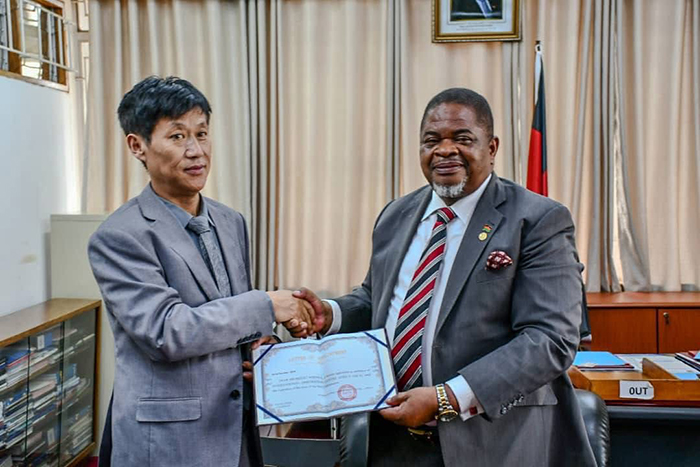
On behalf of the delegation, Mr. Zhang Zhijie, Chairman of IACA, warmly congratulated Minister Msaka on his new appointment and gave a detailed account of IACA's development history and core achievements. Chairman Zhang emphasized that since its establishment, IACA has always adhered to the mission of "promoting the development of the rule of law in Africa and building an international dispute resolution platform". With the strong support of the governments of China and Malawi, as well as the active participation of the business and legal communities, IACA has achieved leapfrog development. The center's original "Four-in-One Special Arbitration Rules" have broken through the limitations of traditional arbitration models, achieved innovations in efficiency improvement, procedure optimization, and cross-border enforcement, and will become an important benchmark leading the innovative development of the global arbitration field.
Regarding the core topic of talent cultivation, Chairman Zhang Zhijie focused on introducing IACA's international training system. Up to now, the center has conducted special training programs for judicial and administrative backbones from 32 African countries, covering key groups such as judges, senior lawyers, law teachers in colleges and universities, and government legal officials. The training content focuses on core areas including international arbitration practice and cross-border application of law, injecting strong impetus into the development of the rule of law talent team in Africa.
Notably, the in-depth cooperation between IACA and the University of Malawi has yielded fruitful results. The joint "Dual Talent Cultivation Program for Common Law and Civil Law" launched by the two sides innovatively offers two educational levels: on-the-job master's and doctoral programs. The curriculum integrates core theories and practical cases of the two legal systems, which not only meets the development needs of Malawi's legal system but also builds an international academic exchange platform for students. The simultaneous establishment of the "International Arbitration" special scholarship not only provides academic incentives for outstanding students but also accurately addresses the educational needs of students from impoverished backgrounds.
After listening carefully, Minister Msaka highly praised the practical measures and remarkable achievements of IACA. He pointed out that Malawi still faces challenges in the field of legal education, such as the disconnection between theory and practice and the shortage of high-end talents. The resources and platform of IACA are the key to solving these problems. He clearly stated that in the future, he will promote the establishment of a regular exchange mechanism between Malawi's education system and IACA. Through joint school-running, faculty exchanges, case sharing, and other means, efforts will be made to accelerate the narrowing of the gap between China and Malawi in legal academic research and practical application. In particular, more interdisciplinary talents will be cultivated in the emerging field of international arbitration to help Malawi integrate into the global rule of law system.
During the talks, Minister Msaka specially thanked IACA for its generous investment in Malawi's education sector. In addition to the scholarship program, IACA's previous efforts in reconstructing infrastructure and donating teaching materials to several impoverished schools in Lilongwe have effectively improved local school-running conditions. Furthermore, the appointment of Minister Msaka as an arbitrator by IACA in 2023 made him deeply feel the recognition and support of IACA for Malawi's legal community.
As an important outcome of this meeting, Minister Msaka revealed that a new International Arbitration Center for Africa is planned to be built in the Parliament Hill area of Lilongwe in the future. Located in a concentration area of national institutions, this site enjoys convenient transportation and significant location advantages. Once completed, relying on the resource advantages of IACA, it will provide world-class training courses, mock arbitration practice opportunities, and cross-border dispute resolution exchange platforms for Malawian students and legal practitioners. It is expected to become a core hub for arbitration talent cultivation in Southern Africa.
Chairman Zhang Zhijie highly appreciated the construction plan of the new arbitration center and promised that IACA will provide comprehensive support in terms of faculty resources, curriculum design, and international resource connection, helping the office building of the new center to be completed and put into effective use at an early date.
This meeting not only deepened the mutual trust and understanding between IACA and Malawi's Ministry of Education, Science and Technology but also clarified the core direction of future cooperation between the two sides. With the continuous deepening of legal education cooperation between China and Malawi, it will surely inject new connotations into the friendly relations between the two countries and contribute more wisdom and strength to the development of the rule of law in Africa and the cause of international arbitration.
Independent, impartial and innovative
Providing extended services to facilitate arbitration and dispute resolution
- home page
- Technology and Services
- Governance of statutory institutions
- case
- telephone:0123-4567890
- mobile phone:+265886688666 +265889988999(Malawi) 13935110379 13303510379(China)
- mailbox:411020882@qq.com
- address:2058, 46 District, Lilongwe City, Republic of Malaw
- Book Fragrance Garden, No. 10 Wangfu Street, Beijing, China

Scan to see more
African International Arbitration Center(AFRICA INTERNATIONAL ARBITRATION CENTRE)
Record number:xxxxxxxx